
Demonstration and Impact Assessment
Evaluating the Effectiveness of New Tools and Methods for Medicanes and High-Impact Weather Forecasting
Focusing on the iteration and coordination of activities related to demonstration and impact assessment, MEDICANES project involves the application of newly developed tools to showcase their usefulness in user communities, particularly experts in numerical weather prediction, Mediterranean cyclone climatology, and medicane research.
The new tools aim to identify, delimit boundaries, and quantify the relevance of warm core systems to medicanes, addressing a fundamental gap in atmospheric dynamics. These methods will utilize Earth Observations (EOs) to discern warm air anomalies and monitor medicanes through wind symmetries around a fixed, cloudless "eye." Detecting such structures is crucial as it highlights the similarities between medicanes and tropical cyclones.
Experimental data assimilation techniques will be applied to explore how these detected substructures influence the numerical weather prediction of medicanes. This work is expected to significantly enhance the accuracy and reliability of forecasting high-impact weather events, leading to better predictions of cyclone tracks and intensities. Additionally, a physical definition of medicanes has been established based on their observed characteristics from satellite data, filling a critical gap in the study of Mediterranean cyclones.
Another aspect of this work involves the understanding of medicanes from an impact perspective, utilizing newly produced products and dedicated atmospheric and oceanic models. This will include examining the complementarity of new EOs with high-resolution models to interpret observed features and identify limitations in predicting or reproducing high-impact weather events in the Mediterranean region. The impacts studied will include storm surges, high sea waves, windstorms, heavy precipitation, and their combinations.
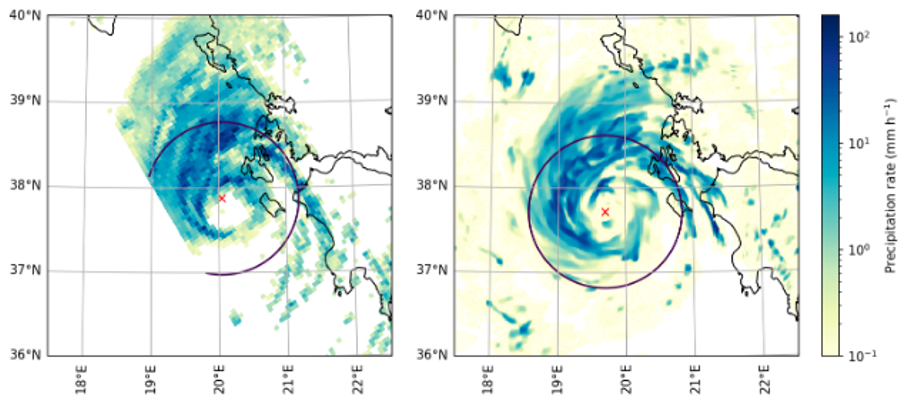 Precipitation related to the spiral bands of Medicane Ianos observed by GPM (left) and simulated by the coupled ocean-wave-atmosphere models Meso-NH, WW3 and CROCO (right).
<>
Precipitation related to the spiral bands of Medicane Ianos observed by GPM (left) and simulated by the coupled ocean-wave-atmosphere models Meso-NH, WW3 and CROCO (right).
<>
On the quantification of socio-economic impacts on local and regional scales
As an integral component of the MEDICANES project’s research objectives, this study focuses on the quantification and analysis of the socio-economic impacts of medicanes on both local and regional scales. A comprehensive understanding of these impacts is essential to assess the true relevance of medicane events across affected areas and to support informed decision-making in risk management and disaster resilience planning.
The scope of this research includes the following key components:
By integrating these elements, the study aims to advance the understanding of the broader impacts of medicanes and contribute to enhancing the resilience and preparedness of vulnerable communities in the Mediterranean region.
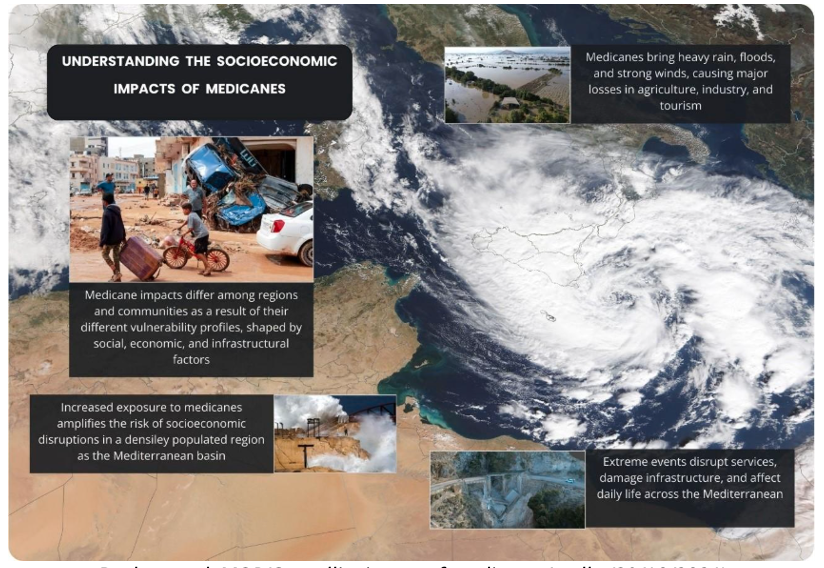 Background: MODIS satellite image of medicane Apollo (29/10/2021)
MEDICANES HAZARD ESTIMATION
To evaluate the influence of medicanes on the ocean, we assess the coastal and marine hazard of medicanes by computing different indicators based on simulated waves and simulated sea levels: the total storm wave energy, the storm power index and the storm erosion potential index.
The total storm wave energy (TSWE) is obtained by integrating the wave power contribution of each sea state over the storm duration. It states the magnitude of an extreme event and it has been already used as parameter to classify and characterize storms. The storm power index (SPI) was introduced by Doland and Davis (1992) to classify Atlantic Coast easter storms. It is a simplified form of the TSWE (which is a more exact calculation of wave power) since it corresponds to the product between the squared significative wave height and the storm duration. The storm erosion potential index (SEPI) incorporates storm tide effects to characterize the potential erosion of sandy beaches. It is based on the analysis of sea levels and storm surges which are considered as a proxy of erosion when two thresholds are overpassed: the mean high higher water (mhhw) for the sea levels and the double of the standard deviation (2SD) of storm surge height for the storm tide levels.
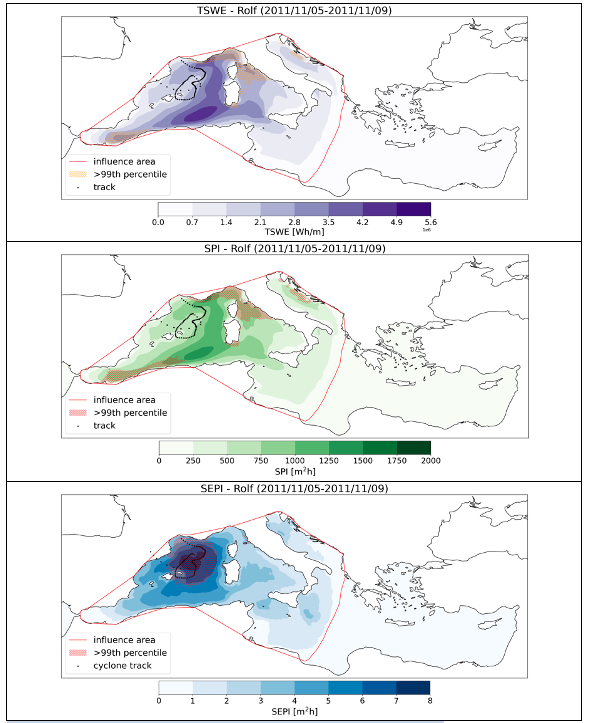 Evaluation of the three hazard indexes (TSWE, SPI, SEPI) for medicane Rolf.