
Medicane Jolina
Cyclone Jolina Observed Transitioning into a Medicane Under the New Observational Framework
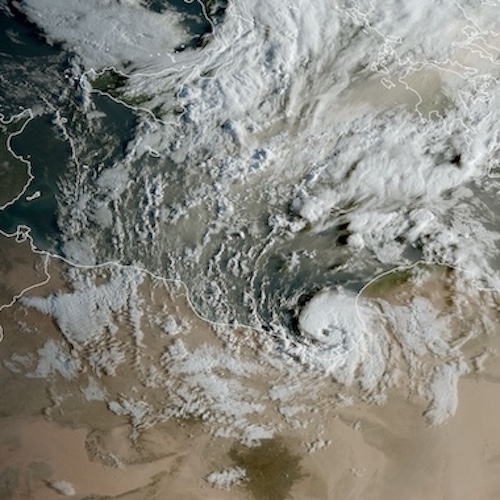
Satellite-based observations collected within the framework of the project indicate that Cyclone Jolina has transitioned into a Mediterranean tropical-like cyclone (medicane) in accordance with the newly established observational definition.
In the last stage of its lifetime, Cyclone Jolina shows the unmistakable fingerprints of a Medicane. A medicane is no longer a vague label. It is, observationally a mesoscale cyclone over the Mediterranean, with a warm core extending upwardin the upper troposphere, a spiral cloud bands and, an eye-like structure within a nearly symmetric wind field. And in Jolina these boxes have been checked one by one as it approached the coast of Libya.
Microwave and infrared satellite data suggest a tropical-like transition underway: from a cold-core, asymmetric system to a compact, diabatically driven warm core, even if it occurred in an unusual period of the year, characterized by a relatively cold SST.
This is the quiet power of Earth Observation: we are no longer debating what to call these storms—we are watching them cross the boundary in real time.
Jolina may not be the strongest system this season. But scientifically, it could be one of the clearest examples yet of a medicane defined as it forms—not just after the fact.

Impacts across the central Mediterranean
Beyond its scientific relevance, Jolina highlights the socio-economic risks associated with Medicanes.
Italy
Libya
These impacts illustrate how even moderate-intensity Medicanes can disrupt infrastructure, transport, and emergency response systems, generating cascading economic effects in exposed coastal regions.
This analysis has been carried out by MEDICANES project team in collaboration with EUMETSAT, and NOAA.
Read more: ESA – Getting to the core of a Medicane