
Scientific Roadmap
Phase 2 — Defining the Future of Medicane Research and Operations
A central deliverable of MEDICANES Phase 2 is a Scientific Roadmap to address future medicane risks. This document will synthesise the achievements of the entire project — Phase 1 and Phase 2 — into concrete, forward-looking recommendations for the scientific community, operational forecasting services, and policy stakeholders. It will serve as a reference framework for the next generation of medicane monitoring, prediction, and risk management.
Medicanes in the Context of Disasters
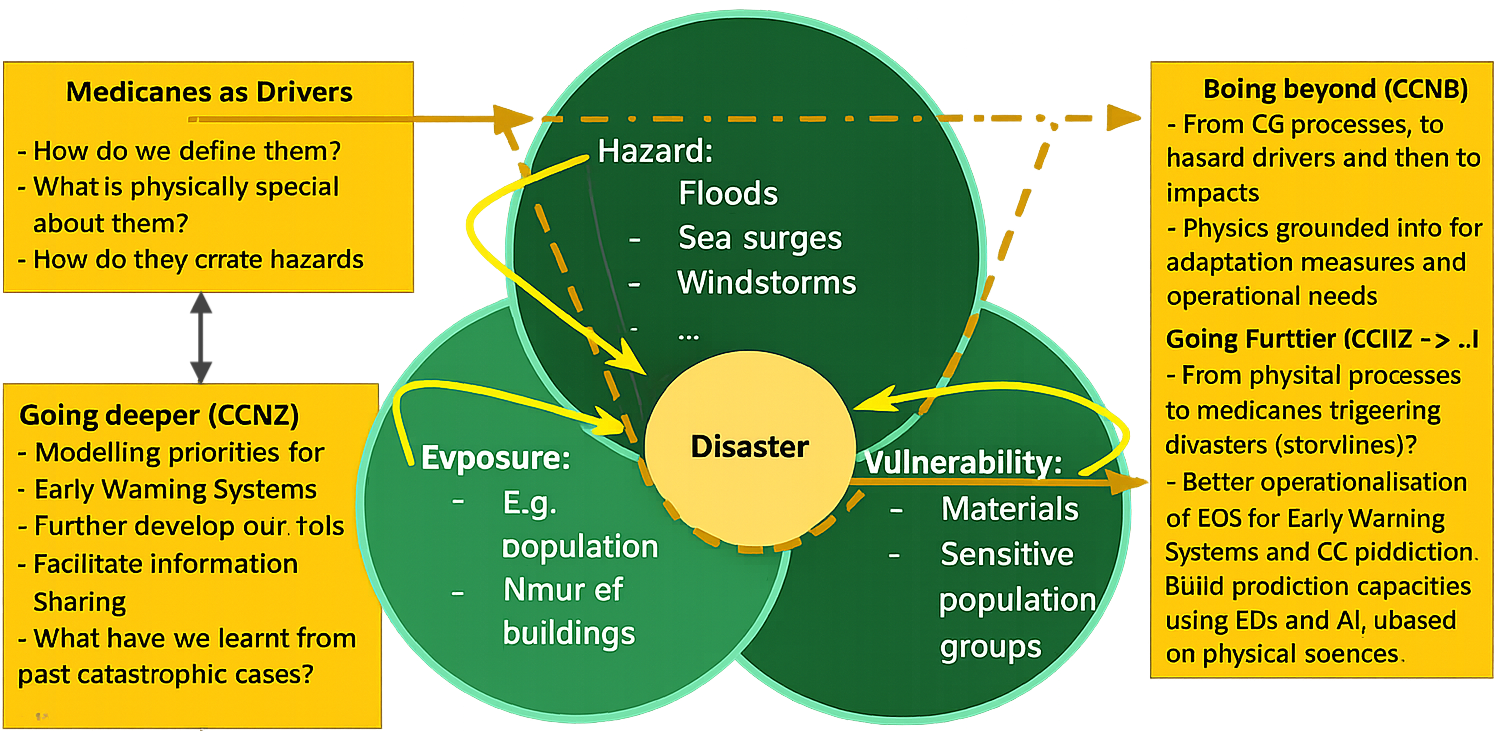
Medicanes are drivers of environmental disasters. Their societal impact arises from the intersection of three factors: the hazard they generate — floods, storm surges, windstorms, coastal erosion — the exposure of the affected areas — population, infrastructure, economic assets — and the vulnerability of those systems to absorb and recover from the impact. Only when all three converge does a medicane event become a disaster, and understanding this interaction is the central challenge that Phase 2 addresses.
Three Levels of Ambition
The roadmap is structured around the progressive evolution of the project's scientific ambition across three levels:
The first phase established the scientific foundations: a community-endorsed definition of medicanes, EO-based detection, monitoring and diagnostics tools, and the first open Medicane Atlas. The key questions addressed were: how do medicanes form, what makes them physically special, and through which atmospheric, marine, and coastal mechanisms do they generate hazards?
Phase 2 translates scientific understanding into quantitative risk information. Priorities include: developing modelling tools in support of Early Warning Systems; advancing satellite-based intensity estimation and medicane classification; facilitating structured information sharing with meteorological services and civil protection authorities; and extracting lessons from past catastrophic events — Zorbas (2018), Ianos (2020), Daniel (2023) — through systematic multi-hazard impact analysis.
The roadmap looks ahead to the next generation of research: moving from physical process understanding to full disaster storylines (from medicane physical processes to societal impact chains); better operationalisation of EO products within Early Warning Systems and climate change prediction frameworks; and building AI-enhanced prediction capacities that remain grounded in physical science.
What the Roadmap Will Cover
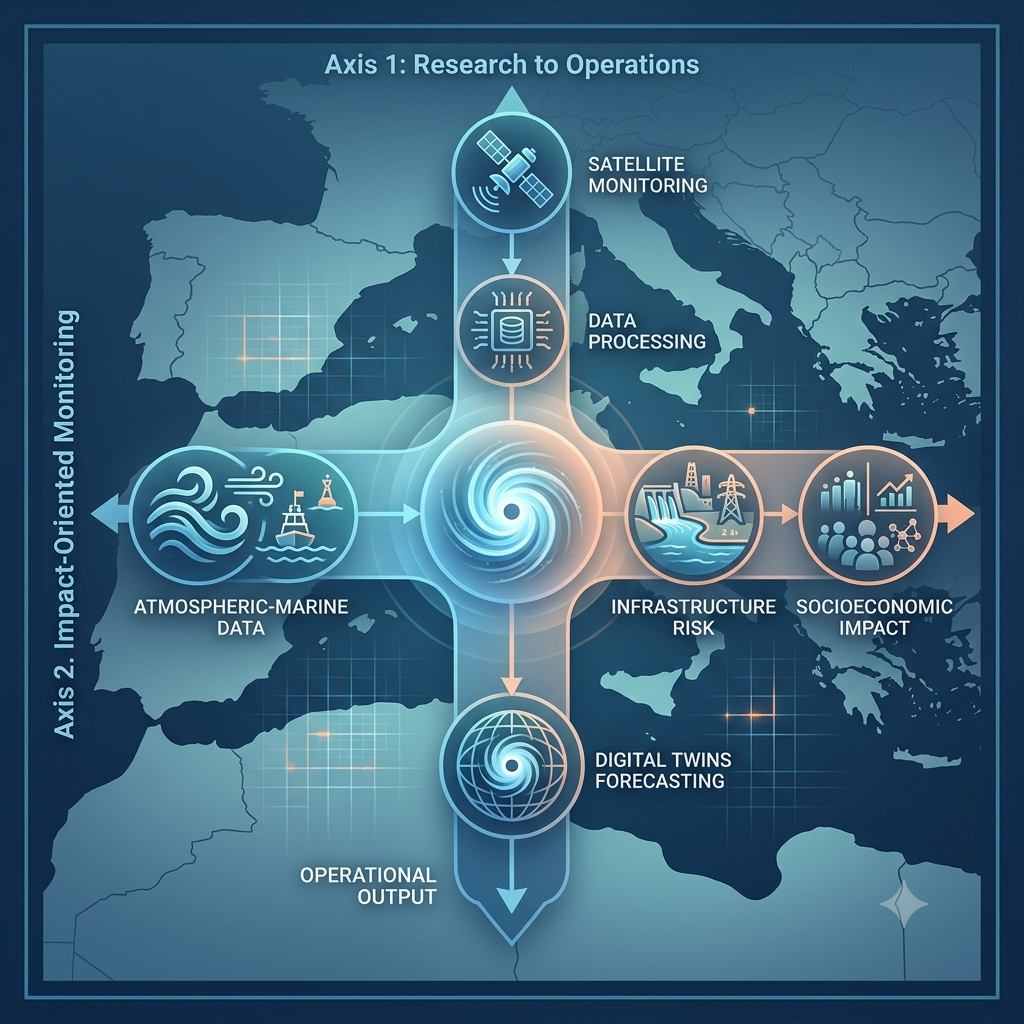
The roadmap is structured around two central axes:
The roadmap will assess how the tools and methods developed across both phases of MEDICANES can be transitioned into operational use. This includes satellite-based intensity estimation, automated medicane classification, multi-hazard footprint construction, and the use of Digital Twins for testing and improving monitoring capability for rare or extreme events. Key gaps limiting the operational uptake of these tools — methodological, observational, and computational — will be explicitly identified and prioritised.
Building on the EO-to-Impact workflow developed in Phase 2, the roadmap will identify future research directions for integrating atmospheric, marine, coastal, and socioeconomic information into coherent impact-oriented frameworks. This covers advancing the connection between EO-derived hazard footprints and indicators of flooding, wind damage, infrastructure disruption, population exposure, and regional economic losses — in line with the WMO impact-based forecasting paradigm.
The Role of Digital Twins in Future Risk Assessment
The roadmap will give particular attention to the emerging role of Digital Twins in supporting impact-based forecasting. Digital Twin outputs — including synthetic medicane scenarios — represent a source of physically consistent event libraries that extend analysis well beyond the small number of observed events. This approach can support risk assessment under extreme or rare conditions, helping decision-makers understand the full range of plausible medicane impacts rather than being limited to the historical record.
International and European Alignment
The roadmap will be developed in close coordination with international and European frameworks that share the project's ambitions, including: